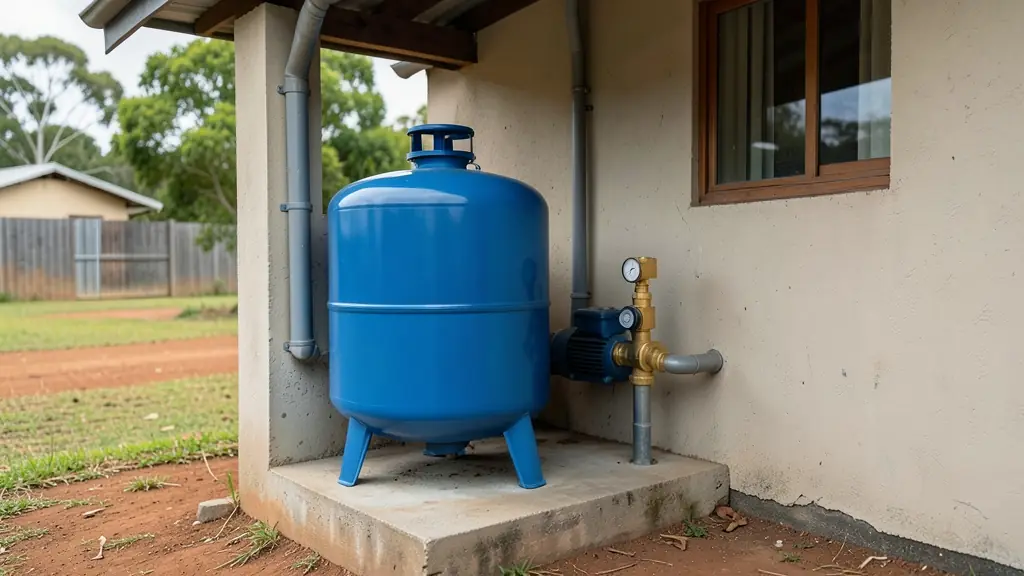
A pressure tank for a water pump is a steel vessel with a rubber bladder or diaphragm inside and a cushion of air behind it. It stores a little water under pressure, so when a tap opens the tank supplies it first and the pump does not start for every glass of water. Fewer starts mean a longer life for the motor and the pressure switch, and steadier pressure at the taps. This page covers the types and sizes, the pre-charge, why pumps cycle and when a tank needs attention.
Bladder and diaphragm tanks
In a bladder tank the water sits inside a rubber bag and air surrounds it. The bladder can often be replaced when it fails. In a diaphragm tank a fixed rubber sheet separates air and water; the diaphragm is usually not replaceable, so the whole tank is changed. Either type stops the water touching the steel shell, which limits rust. Old plain steel tanks without a bladder lose their air over time and need regular draining and recharging. If you have one and it keeps waterlogging, a bladder tank is usually the simpler fix.
Sizes and pre-charge
Pressure tanks are sold in litres; 24 L, 50 L and 100 L are common sizes, often with larger ones for farms and buildings. A bigger tank gives longer runs and fewer starts. Only part of the tank's volume is usable water, since the rest is air. The air pre-charge is usually set a little below the pump's cut-in pressure, measured with the tank empty of water. Too much or too little air shortens the time between starts. The supplier will match the size and pre-charge to your pump and pressure switch.
Why a pump cycles fast
If your pump clicks on and off every few seconds while a tap runs, the tank is the first thing to check. Common causes are a waterlogged tank (air lost or a burst bladder), a pre-charge set wrong, a tank too small for the pump, or a leak somewhere in the house. A quick check: tap the top of the tank; a full sound all the way up suggests it is full of water. Fast cycling heats the motor and wears the switch, so do not leave it. A booster with a VSD may need only a small tank.
Where to fit it and what to ask
The tank goes on the outlet side of the pump, after the non-return valve and close to the pressure switch, so the switch reads the tank pressure. Fit an isolating valve so the tank can be changed without draining the house. Keep it out of direct sun and off wet ground, since rust on the base and seams is what usually ends a tank. Check the pre-charge with a tyre gauge every year or so. Ask for the volume, the maximum working pressure, whether the bladder is replaceable and the warranty. For whole systems, see tank pumps and borehole pumps.
What to put in your request
- The pump it works with and its size
- Cut-in and cut-out pressure if known
- Size of the existing tank in litres
- What is wrong: fast cycling, leaks, rust
- Where the tank stands and space around it
Pressure Tanks for homes, farms and businesses
- Homeowners: a small tank on the booster so the pump stops starting for every tap
- Smallholdings and plots: a larger tank on the borehole system for steady pressure to the house
- Farms: large vessels on borehole and irrigation systems to reduce starts
- Complexes, estates and body corporates: vessels on communal pressure sets and garden systems
- Offices, shops, hotels and lodges: pressure vessels on building pressure sets and backup water
- Factories, plants and depots: vessels on process water and wash bay pump systems
- Mines and quarries: pressure vessels on site water and wash down systems
- Municipalities, schools and clinics: vessels on small supply schemes and public building boosters
- Contractors and drillers: plumbers replacing waterlogged tanks and setting pre-charge
Frequently asked questions
How do I know if my pressure tank is waterlogged?
Can I replace the bladder instead of the tank?
Do I need a pressure tank with a pressure controller?
Will you come out and replace my tank?
Pressure Tanks by province and city
- Johannesburg
- Pretoria
- Centurion
- Midrand
- Sandton
- Randburg
- Roodepoort
- Krugersdorp
- Randfontein
- Germiston
- Boksburg
- Benoni
- Kempton Park
- Alberton
- Vanderbijlpark
- Vereeniging
- Durban
- Pinetown
- Pietermaritzburg
- Richards Bay
- Newcastle
- Ladysmith
- Gqeberha (Port Elizabeth)
- East London
- Kariega (Uitenhage)
- Mthatha
- Cape Town
- Bellville
- Paarl
- Stellenbosch
- George
- Worcester
- eMalahleni (Witbank)
- Middelburg
- Secunda
- Mbombela (Nelspruit)
- Rustenburg
- Brits
- Klerksdorp
- Potchefstroom
- Mahikeng
- Polokwane
- Tzaneen
- Kimberley
- Upington
- Bloemfontein
- Welkom
- Sasolburg