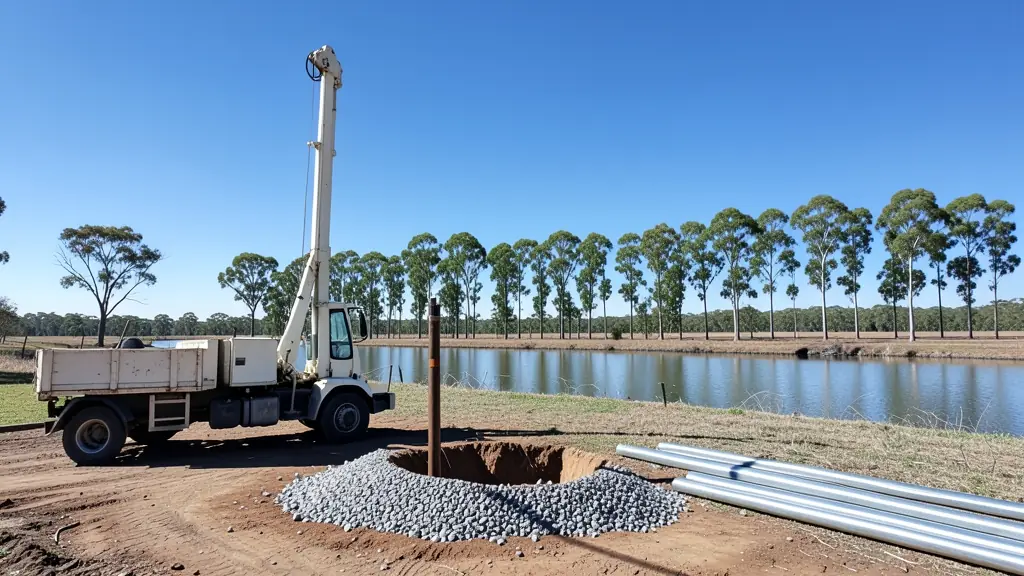
Borehole drilling comes before any pump. A driller sets up a rig, drills down until it reaches water bearing rock or gravel, lines the top of the hole with casing, and tests how much water the hole gives. Nobody can promise water at a given spot, but good siting improves the odds, and a proper yield test tells you what pump the hole can carry. Send one request with your area and what the water is for, and we pass it to independent drillers who work there, who quote you directly.
Siting the hole
Some owners drill where it is convenient; many first pay a hydrogeologist or an experienced siter to do a geophysical survey, which measures the ground to find likely water bearing fractures or layers. A survey improves the chances and helps choose between spots, but it does not guarantee water, and an honest siter says so. Practical things matter too: the rig needs access, and the hole should be away from septic tanks, drains, power lines and buried services. Ask neighbours how deep their holes are and what they give. It is a useful guide, though water can differ over short distances.
Drilling, casing and depth
In hard rock, rotary percussion drilling with air is common: a hammer at the bottom of the drill string breaks the rock and compressed air blows the chips out. The soft upper layers are lined with steel or uPVC casing so the hole does not collapse. In South Africa holes are often 30 m to 150 m deep, sometimes deeper, depending on the ground and where the water lies. Drillers usually charge per metre drilled, plus casing per metre, a setup fee and travel. A hole that finds no water is still paid for at many drillers, so ask before they start.
Yield and water quality tests
After drilling, a yield test pumps the hole for a period and records how many litres per hour it gives and how far the water level falls. That sets the size of the borehole pump and the depth it hangs at: a pump bigger than the yield draws the hole dry and burns out. On low yield holes, a solar borehole pump filling a tank slowly through the day can suit well. If the water is for drinking, have it tested by a laboratory first. Then the pump goes in; see borehole pump installation.
Rules and what a drilling quote should list
Normal household use of borehole water is generally allowed, but larger abstraction may need to be registered or licensed with the Department of Water and Sanitation: check if you plan to irrigate or supply a business. Some municipalities, including Johannesburg and Cape Town, ask for boreholes to be registered and have their own rules, so check with your municipality. Parts of Gauteng sit on dolomite, where drilling needs care and sometimes a geotechnical report. A clear quote lists:
- The rate per metre drilled and the expected depth
- Casing type and rate per metre
- Setup, travel and site access
- What a dry hole costs
- Yield and water tests, if included
What to put in your request
- The area and access for a drilling rig
- What the water is for: garden, house, farm
- Depth and yield of holes nearby, if known
- Survey, yield test and water test wanted
- Whether you also want the pump installed
Borehole Drilling for homes, farms and businesses
- Homeowners: a garden borehole in the suburbs drilled to ride out water cuts
- Smallholdings and plots: one borehole sited and drilled for the house, animals and a veg garden
- Farms: several holes surveyed and drilled for stock water and irrigation
- Complexes, estates and body corporates: a communal borehole drilled for the gardens of a complex or security estate
- Offices, shops, hotels and lodges: a lodge, school or hotel drilling a borehole for backup water
- Factories, plants and depots: a factory borehole for process water, with licensing checked first
- Mines and quarries: boreholes drilled for site water supply and groundwater monitoring
- Municipalities, schools and clinics: village water project boreholes drilled, tested and equipped
- Contractors and drillers: a building contractor arranging a borehole for a new development
Frequently asked questions
Do you drill boreholes yourselves?
What does borehole drilling cost?
Will I find water?
Do I need permission to drill a borehole?
Borehole Drilling by province and city
- Johannesburg
- Pretoria
- Centurion
- Midrand
- Sandton
- Randburg
- Roodepoort
- Krugersdorp
- Randfontein
- Germiston
- Boksburg
- Benoni
- Kempton Park
- Alberton
- Vanderbijlpark
- Vereeniging
- Durban
- Pinetown
- Pietermaritzburg
- Richards Bay
- Newcastle
- Ladysmith
- Gqeberha (Port Elizabeth)
- East London
- Kariega (Uitenhage)
- Mthatha
- Cape Town
- Bellville
- Paarl
- Stellenbosch
- George
- Worcester
- eMalahleni (Witbank)
- Middelburg
- Secunda
- Mbombela (Nelspruit)
- Rustenburg
- Brits
- Klerksdorp
- Potchefstroom
- Mahikeng
- Polokwane
- Tzaneen
- Kimberley
- Upington
- Bloemfontein
- Welkom
- Sasolburg