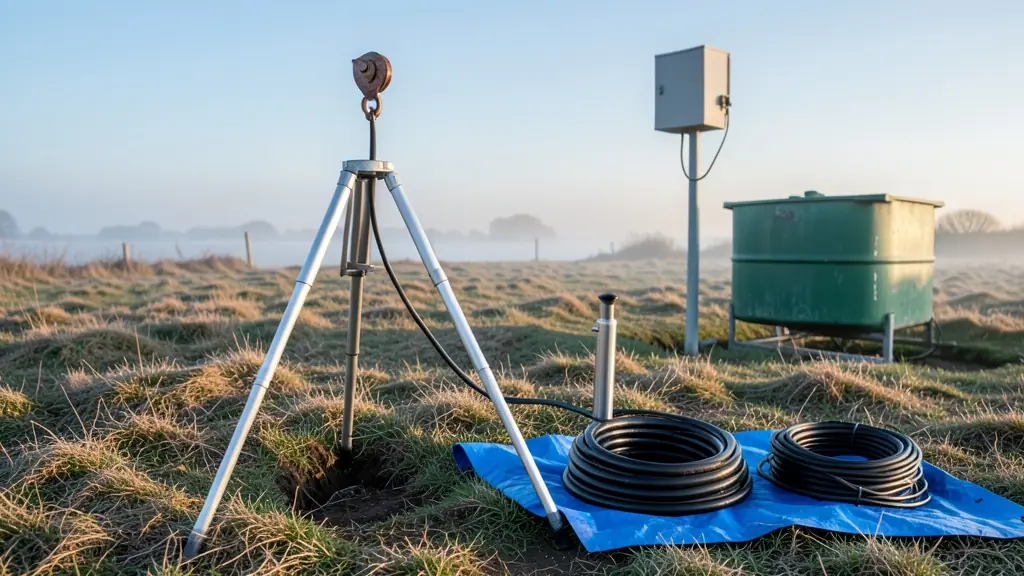
Borehole pump installation is the step that turns a drilled hole into running water. The pump is joined to its drop pipe, cable and safety rope, lowered to the right depth, and connected at the top to a cap, a valve, the pipe to your tank or house and a control box. Done well, it runs for years. Done badly, it pulls sand, runs dry or ends up at the bottom of the hole. Send one request and we pass it to independent borehole installers in your area, who quote you directly.
How the pump goes down the hole
The installer lays the pump out beside the borehole and joins the flat drop cable to the motor lead with a splice kit or resin so the joint is sealed against water. The drop pipe, usually HDPE poly pipe for domestic sets or steel column pipe for big ones, is fitted to the pump outlet, and a stainless or nylon safety rope is tied to the pump so it can always be lifted out. The cable is clipped or tied to the pipe every few metres. Light sets are lowered over a tripod with a pulley; deep or heavy sets often need a crane truck. Read more about the pump itself on our borehole pumps page.
Setting the depth
The yield test from the driller tells the installer two things: how much water the hole gives and how far the water level drops while it is pumped. The pump should sit below that lowest pumping level, and usually some metres above the bottom of the hole, so it stays covered without drawing sand. Set too high, it runs dry as the level falls; set too low, it wears out on sand. If there is no yield test, ask for one before the pump is chosen. Our borehole drilling page explains what the test involves.
What gets fitted at the surface
The top of the hole is where most of the visible work happens:
- A borehole cap or sanitary seal that holds the pipe and keeps out dirt, insects and surface water
- A non-return valve so water does not run back down the pipe
- The pipe to the tank or house, often buried, with an isolating valve
- A control box with dry run and surge protection
- A water level probe or another dry run sensor
The electrical side, from the supply to the control box and down to the pump, should be done by a qualified electrician. Ask for a Certificate of Compliance for the fixed wiring.
The test run and what the quote must state
Once everything is connected, the installer runs the pump and measures the flow at the tank and the current the motor draws, to confirm it works within its range and the protection is set right. Keep those readings: they help with fault finding later. A clear quote states the pump and motor size, the depth it is set at, the pipe class and the cable size and length, what is supplied at the surface, whether a tripod or a crane truck is needed, who does the electrical work, and what guarantee covers the workmanship.
What to put in your request
- Borehole depth and yield test results
- Where the water goes and how far
- Power at the borehole: single or three phase
- Existing pump, or supply a new one
- Who does the electrical work
Borehole Pump Installation for homes, farms and businesses
- Homeowners: a garden borehole in the suburbs fitted with a pump, cap and pipe to a tank
- Smallholdings and plots: one pump feeding the house, the animals and a veg garden through a tank on a stand
- Farms: a deeper three phase set lowered by crane truck to fill stock troughs and a reservoir
- Complexes, estates and body corporates: a communal borehole pump fitted with protection to water the gardens of a complex
- Offices, shops, hotels and lodges: a lodge or school borehole set up to fill storage tanks for backup water
- Factories, plants and depots: a borehole pump feeding process or wash bay water to a tank at a factory
- Mines and quarries: site supply boreholes equipped with pumps, pipe and control panels
- Municipalities, schools and clinics: village boreholes equipped with pumps, caps and control panels for a water project
- Contractors and drillers: a driller or plumber subcontracting the pump install after the hole is drilled
Frequently asked questions
Do you install borehole pumps yourselves?
Can I install a borehole pump myself?
How deep should the pump be set?
What should I send for an installation quote?
Borehole Pump Installation by province and city
- Johannesburg
- Pretoria
- Centurion
- Midrand
- Sandton
- Randburg
- Roodepoort
- Krugersdorp
- Randfontein
- Germiston
- Boksburg
- Benoni
- Kempton Park
- Alberton
- Vanderbijlpark
- Vereeniging
- Durban
- Pinetown
- Pietermaritzburg
- Richards Bay
- Newcastle
- Ladysmith
- Gqeberha (Port Elizabeth)
- East London
- Kariega (Uitenhage)
- Mthatha
- Cape Town
- Bellville
- Paarl
- Stellenbosch
- George
- Worcester
- eMalahleni (Witbank)
- Middelburg
- Secunda
- Mbombela (Nelspruit)
- Rustenburg
- Brits
- Klerksdorp
- Potchefstroom
- Mahikeng
- Polokwane
- Tzaneen
- Kimberley
- Upington
- Bloemfontein
- Welkom
- Sasolburg