
Overview of Submersible Pumps
Definition and primary uses
Across South Africa, reliable water movement is a quiet engine of daily life; energy costs drop when submersible systems run efficiently! Readers often ask how does a submersible pump work, and the answer unfolds with quiet grace: an underwater motor drives an impeller that pushes water into a discharge line.
A submersible pump is a hermetically sealed unit designed to operate underwater. The motor and pump chamber resist water and corrosion, reducing leaks and cavitation. When powered, rotors boost water pressure, lifting it through piping to storage tanks, wells, or treatment systems.
- Groundwater extraction from wells
- Irrigation and farm water supply
- Sewage lifting for drainage
Compact borehole systems and industrial sumps illustrate how practicality meets enduring elegance in water management.
Where submersible pumps are installed
In South Africa’s sun-warmed landscapes, water anonymity becomes a steadfast ally of daily life. “Water is energy’s patient ally,” a seasoned engineer insists, and many readers ask: how does a submersible pump work? The answer arrives with quiet precision, beneath the surface and inside a sealed heart!
This hermetically sealed unit lives underwater, where the rotor and impeller work in harmony, pushing water through discharge lines toward tanks, wells, or treatment systems. The motor–pump chamber resists water and corrosion, reducing leaks and cavitation even in mineral-rich soils.
- Borehole and well installations for groundwater recovery
- On-farm irrigation and storage systems
- Wastewater lifting and drainage for compact facilities
In compact borehole systems, the elegance lies in durable seals, efficient motor design, and the quiet march of water from depths to daylight.
Advantages over traditional pumps
South Africa’s sun-warmed landscapes demand reliable water—each borehole a lifeline. When a submersible pump hums softly beneath the surface, the result feels almost magical: how does a submersible pump work? It begins with a hermetic heart—rotor and impeller spinning in sealed harmony, lifting water from darkness toward daylight with quiet authority.
Its submerged heart offers a spectrum of practical advantages over surface pumps: no priming, tighter seals against leaks, and reduced cavitation risk. The motor runs cool inside water, delivering efficient, steady flow from depth. A compact, corrosion-resistant assembly fits tight spaces and minimizes maintenance, proving reliable in sun-warmed environments and compact settings where space matters.
What to know before buying
In South Africa’s sun-warmed countryside, reliable water is a quiet lifeline. “how does a submersible pump work?” The answer unfolds as a compact duet of metal and water, a hermetic heart coaxing life from depth with quiet authority.
Before you buy, consider depth, yield, power, and resilience—the kind of factors that keep water flowing when the afternoon heat arrives.
- Depth rating and expected yield
- Electrical supply, motor cooling, and efficiency
- Seal quality, corrosion resistance, and build robustness
- Availability of parts and local service in South Africa
In compact spaces or remote bores, the submerged engine spins a patient tale, turning darkness into daylight with quiet, loyal motion!
Key Components and How They Work
Motor and sealing technology
Billions of liters move beneath our feet every day, a quiet testament to engineering that never shouts. So, how does a submersible pump work? In the water’s deep theatre, a sealed motor drives the heart of the system, turning potential energy into a steady, dependable flow.
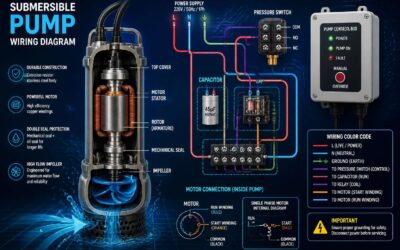
First, the motor chamber is oil-filled and hermetically sealed to stay cool and dry. The stator’s copper windings create a magnetic field that the rotor faithfully follows, spinning the impeller and coaxing water upward. All of this happens while outside water is kept at bay by a robust sealing system.
- Motor chamber sealed with oil for cooling and insulation
- Impeller that converts rotational energy into thrust
- Sealing technology, including a mechanical face seal and secondary seal
- Protective casing and intake screen to block debris
These elements work in concert for South Africa’s diverse water scenarios, delivering dependable duty with minimal fuss.
Impeller, diffuser and pump housing design
In the quiet depth, three elements hold the secret: the impeller, the diffuser, and the pump housing. To answer how does a submersible pump work, picture rotational energy transformed into a measured river of water. The impeller drives outward, the diffuser curbs velocity and raises pressure, and the housing guides the stream with a plume of efficiency that stays submerged and silent.
- Impeller: converts rotation into outward thrust, driving the water flow
- Diffuser: slows and redirects the jet to boost pressure without shock
- Pump housing: shapes the channel, minimizes turbulence and seals the path
Designed for boreholes and flood plains across South Africa, these components resist debris, minimize turbulence, and keep heat in check.
Together, they deliver steady flow, even in dusty, variable water conditions common in South Africa.
Electrical connections and controls
Water is life, and beneath South Africa’s quiet yards a tiny powerhouse keeps it flowing. In understanding how does a submersible pump work, the answer rests in electrical connections and controls that turn submerged energy into a patient, steady stream for boreholes and tanks.
Within the realm of electrical connections and controls, three features matter:
- Sealed, rugged wiring and waterproof cable entries
- Motor starter with overload protection and soft-start
- Thermal sensors and automatic cutouts to guard against overheating
These elements keep the submerged motor quiet, efficient, and ready to meet variable water conditions.
Materials and durability considerations
Across South Africa’s sun-drenched yards, water is life and time is precious. “Water is life,” echoes across rural wells, and the answer to how does a submersible pump work often lies beneath the surface, where a quiet powerhouse keeps flows steady.
Key components do the heavy lifting below ground: a rugged core, a protective seal package, and wear-resistant surfaces. Electricity becomes pressure, guided by precise tolerances and clean fits that endure sand and grit.
Materials and durability considerations steer every choice, from housing to bearings.
- Stainless steel or high-grade cast iron for housings
- Ceramic or carbon seals for grit resistance
- Corrosion-resistant coatings and epoxy linings
For those who rely on boreholes to feed families and livestock, the science is a quiet ally—unseen, steady, and true.
Operating Principles and Performance
Submersible design and pressure resistance
Pressure is the quiet test that reveals a submersible’s character. To answer how does a submersible pump work, examine its sealed heart: a motor inside a water-filled chamber that keeps heat in check while turning an impeller. The shaft is shielded by labyrinth seals and durable bearings, guarding the electronics from groundwater. Water enters through a protected inlet and exits through a pressure-rated outlet, reducing cavitation in deep boreholes. In SA, boreholes and flood-prone basins push these pumps to their limits.
Performance and pressure resistance go hand in hand. In SA borehole and sump environments, submersible designs rely on corrosion-resistant housings, resilient seals, and cooling through the surrounding liquid. Balanced hydraulics, durable bearings, and meticulous assembly ensure steady flow and head across variable loads.
- Sealed motor chamber (oil- or water-filled) for lubrication
- Pressure-rated exterior with reinforced seals
Flow rate, head, and efficiency
Operating principles hinge on a sealed motor chamber powering an underwater impeller, turning electricity into fluid motion. Flow rate—the volume moved per second—and head—the height water is raised to—define performance and efficiency. The surrounding liquid cools the motor, preserving headroom as demand grows. In conversation, how does a submersible pump work? It’s a compact, water-loving engine that stays submerged and primed by design.
Three pillars unlock its performance:
- Flow rate and head balance: impeller size and motor speed set the water moved at a given lift.
- Efficiency envelope: hydraulic losses, bearing friction, and seal integrity shape energy use.
- Depth and load dynamics: submergence depth affects cooling and cavitation risk under varying demands.
In South Africa, boreholes and flood-prone basins test these dynamics daily. A pump built with corrosion-resistant housings and robust seals delivers a steady, cavitation-free flow across shifting groundwater levels. When performance stays reliable, the relationship between flow, head, and efficiency looks less like fate and more like a well-scripted routine.
Priming behavior and self-priming variants
Operating principles hinge on a sealed motor chamber that powers an underwater impeller, turning electricity into fluid motion. The pump sits submerged, so the water itself cools the motor and helps keep headroom intact as load grows. How does a submersible pump work? It starts with a flooded housing and a quiescent input, then the impeller spins, pushing water through the diffuser and out the discharge flange.
Performance priming behavior follows the flooded-prime rule: no empty suction and no external priming needed. In coastal basins and basements alike, models with self-priming variants use check valves and a careful seal to restart quickly after brief dry spells. They can tolerate brief rises in lift but cavitation returns if cooling falters or pressure surges occur.
Impact of rotor design on vibration and noise
Vibration management in submerged pumps can shave up to 40% off energy loss—the statistic that makes engineers hum. How does a submersible pump work becomes a subtler question when rotor design governs cadence as surely as the impeller governs flow. A finely balanced rotor spins with a measured hush, letting bearings breathe and the motor stay cool in a sealed cavern. In practical terms, smooth rotation lowers dynamic load and preserves headroom as duty grows.
Key rotor design choices shape performance.
- Precise dynamic balancing to erase residual eccentricity
- Robust bearings and damped mounting to swallow transmitted waves
- Strategic mass distribution and stiffness to dodge resonance at operating speeds
These elements mingle with cooling water, diffuser geometry, and impeller trim to modulate noise, producing an acoustic footprint that matters in coastal basins and basements alike. Quiet operation can be as critical as flow and head when installations share space with living areas and infrastructure.
Sizing basics and efficiency tips
Operating principles for submersible pumps hinge on a simple truth: the unit travels underwater with no air intake, its sealed motor coaxially marrying an impeller to a generated head. how does a submersible pump work, the answer lies in submergence—fluid surrounds the motor, absorbing heat and damping vibration, while the impeller converts electricity into flow toward the discharge. In a submerged chamber, quiet efficiency blooms as duty climbs and cooling remains constant.
Performance sizing rests on balancing flow against head, while respecting system losses and suction conditions. In South Africa’s water-scarce basins, efficiency matters. The goal is a duty point near the best efficiency point, with headroom for seasonal variation and a motor that remains within thermal limits. Use manufacturer performance curves to validate assumptions—and keep efficiency in view as a constant companion.
- Flow rate required by the application
- Head and friction losses in piping
- Duty cycle and cooling margin
Installation, Sizing, and Maintenance
Site preparation and installation best practices
Installation requires a clean footprint and a stable base. In SA, ensure the pump sits level, the electrical entry is protected, and the discharge line is supported to prevent strain. Clear the area of debris and keep the setup dry to avoid headaches later.
- Clear the installation zone of loose soil and stones
- Secure the power and control cables with strain relief
- Test fittings for leaks before submersion
Sizing blends head, flow, and duty cycle. Match the bore to your water needs, mindful of seasonal variations in South Africa. For context, how does a submersible pump work. The answer lies in a sealed motor turning a water-filled chamber, driving an impeller to create pressure.
Maintenance is about consistency. Periodic checks of seals and cables, backfill moisture, and vibration monitoring keep performance steady.
Sizing a pump for wells, sumps, and drainage
Installation in South Africa requires more than dropping a unit into a bore or sump. Create a clean footprint and a stable base, ensure the electrical entry is protected, and keep the discharge line supported to prevent strain. A dry, debris-free zone saves headaches later.
Sizing a pump for wells, sumps, and drainage blends head, flow, and duty cycle. For seasonal variations in South Africa, match bore size to water needs. The question how does a submersible pump work is answered by a sealed motor turning a water-filled chamber, driving an impeller to create pressure.
Maintenance hinges on consistency. Periodic checks of seals and cables, backfill moisture, and vibration monitoring keep performance steady. Consider a simple cadence:
- Check seals and cables
- Monitor backfill moisture
- Track vibration and noise
Maintenance routines seals and bearings
Installation in South Africa demands more than a plunge and a plug. Create a clean footprint, a stable base, and a dry, debris-free zone—your shield against headaches. In considering how does a submersible pump work, a sealed motor embraces a water-filled chamber, turning an impeller to coax pressure from the depths.
Sizing for wells, sumps, and drainage blends head, flow, and duty cycle. In SA, match bore size to water needs and anticipate seasonal variation. Consider these elements:
- Head and flow requirements
- Duty cycle compatibility
- Energy efficiency and peak demand
Maintenance hinges on consistency. Periodic checks of seals and cables, backfill moisture, and vibration monitoring keep performance steady. Revisiting how does a submersible pump work clarifies these maintenance routines for seals and bearings, a patient, quiet vigil:
- Seals and bearings condition
- Backfill moisture state
- Vibration and noise patterns
Electrical safety and startup considerations
Installation in South Africa’s heat and geology is a ritual of restraint and respect—no plunge-and-plug mentality here. Build a clean footprint, a stable base, and a dry, debris-free zone. To frame how does a submersible pump work, you must honor seals, cable routes, and backfill moisture.
Sizing for wells, sumps, and drainage merges head, flow, and duty cycle. In SA, match bore size to water needs and anticipate seasonal variation. Consider these elements:
- Head and flow requirements
- Duty cycle compatibility
- Energy efficiency and peak demand
Maintenance hinges on consistency. Periodic checks of seals and cables, backfill moisture state, and vibration patterns keep performance steady. In SA, electrical safety and startup considerations deserve calm, structured attention as you monitor rotor vibration, seal wear, and bearing play.
Troubleshooting and Support
Common performance issues and diagnostic steps
Across rural South Africa, 60% of submersible pump faults trace to power delivery or priming issues, not mysterious failure. Readers often ask: how does a submersible pump work? It stays sealed and submerged, its motor turning an impeller that lifts water into the discharge while keeping the contents clean. When performance falters, practitioners read the signs rather than guesswork.
- Reduced, irregular, or no flow leaving the pump
- Unusual heat, humming, or bearing noise
- Frequent electrical trips or a tripped breaker
- Water leaking around seals or motor housing
Our regional support network stands as a chorus of guides, offering steady, culturally attuned guidance and remote diagnostics to keep systems singing.
Electrical fault indicators and testing methods
In the sun-warmed hills of rural South Africa, a borehole hums with quiet resilience—until power dips or priming falters. Curiously, how does a submersible pump work guides our hands—watch the signs, not guess at shadows. When the rhythm falters, the fault becomes a chorus, not a mystery.
Electrical fault indicators you can hear and see rise like weather:
- Frequent breaker trips or unstable supply voltage
- Unusual heat on the motor housing or a faint hum
- Disrupted flow paired with erratic current draw
- Moisture or discoloration around seals and wiring
Testing methods listen to the system’s story at a high level: assess supply stability, insulation integrity, and grounding continuity. Our regional support network stands as a chorus, offering steady, culturally attuned guidance and remote diagnostics to keep systems singing.
Repair vs replacement decision criteria
When a borehole stalls in South Africa’s rural hills, troubleshooting becomes a narrative of worn seals and quiet motors. Understanding how does a submersible pump work helps hands read symptoms rather than chase shadows, turning a moment of uncertainty into a coherent story of the system.
Repair versus replacement hinges on several criteria. Evaluate what you’re facing now and what you’ll gain later:
- Current pump age and known failures
- Repair versus replacement cost, downtime, and disruption
- Potential energy efficiency gains from newer models
- Parts availability, warranty coverage, and local support
In our regional support network, decisions are guided by clarity and continuity, ensuring the system continues to sing with minimal interruption.
Warranty, servicing options, and when to call a pro
In the dry season, a steady trickle from the borehole can mean the difference between bread on the table and an empty kitchen. Understanding how does a submersible pump work isn’t just theory—it’s practical literacy that keeps a homestead calm when a fault threatens the day. When trouble arises, the support backbone is the warranty and the service network that travels from town to veld, keeping faith with your water supply.
How the right troubleshooting and support warranty and servicing options are framed matters. Consider these core pillars:
- Warranty coverage and regional support reach
- Servicing options (on-site visits, workshop servicing, or mobile technicians)
- Guidance on when to call a pro, based on the fault’s complexity and safety considerations
With clarity in these areas, your system remains steadier, even as the hills around you shift with the seasons.

0 Comments